


Return to Tangibles – Act I Update
© 2026 Sarmaya Partners, LLC
Sept. 15, 2026

The world wakes up to the commodity cycle
“All we have to decide is what to do with the time that is given us.”
– Gandalf, The Fellowship of the Ring, J.R.R. Tolkien
In May 2024 we published our inaugural paper on the Return to Tangibles: our view that the next major secular market theme will be a commodity super-cycle. We posited that this renewed investment and growth cycle in commodities would be driven by a series of macro, geopolitical and fundamental catalysts, shifting the market leadership to tangible assets. Two years later, the Return to Tangibles continues to play out as we see Act I ending and Act II getting underway in this three-act secular theme.
This paper is the first in a three-part series that covers the Return to Tangibles secular theme. It serves as an update to that 2024 paper, covering Act I: what is Return to Tangibles, the ingredients and catalysts that started it, and how it has progressed in the intervening years. We will delve into the current transition to Act II and how we see it unfolding in the next paper. Then we will wrap up this three-part series with a note on Act III, discussing the milestones, catalysts and potential outcomes as the Return to Tangibles era unfolds.
Bottom line upfront:
- The Return to Tangibles secular commodity theme began in 2021 when inflation was reawakened from its decades-long slumber, triggered by the pandemic supply shocks combined with the monetary and fiscal stimulus response.
- Over the years a series of catalysts have coalesced with underlying macro drivers and attractive fundamentals to pull the world, reluctantly, into the tangibles secular cycle.
- We believe the first phase of the Return to Tangibles secular theme, where investors wake up to the new market regime, is ending and the next phase is dawning as geopolitics, national security, inflation, fiscal health and elevated rates put real, tangible assets at the forefront.
- Return to Tangibles’ underlying sub-theme exposures to energy and precious metals and their equities are likely to lead in this phase.

The world wakes up to the commodity cycle
“All we have to decide is what to do with the time that is given us.”
– Gandalf, The Fellowship of the Ring, J.R.R. Tolkien
In May 2024 we published our inaugural paper on the Return to Tangibles: our view that the next major secular market theme will be a commodity super-cycle. We posited that this renewed investment and growth cycle in commodities would be driven by a series of macro, geopolitical and fundamental catalysts, shifting the market leadership to tangible assets. Two years later, the Return to Tangibles continues to play out as we see Act I ending and Act II getting underway in this three-act secular theme.
This paper is the first in a three-part series that covers the Return to Tangibles secular theme. It serves as an update to that 2024 paper, covering Act I: what is Return to Tangibles, the ingredients and catalysts that started it, and how it has progressed in the intervening years. We will delve into the current transition to Act II and how we see it unfolding in the next paper. Then we will wrap up this three-part series with a note on Act III, discussing the milestones, catalysts and potential outcomes as the Return to Tangibles era unfolds.
Bottom line upfront:
- The Return to Tangibles secular commodity theme began in 2021 when inflation was reawakened from its decades-long slumber, triggered by the pandemic supply shocks combined with the monetary and fiscal stimulus response.
- Over the years a series of catalysts have coalesced with underlying macro drivers and attractive fundamentals to pull the world, reluctantly, into the tangibles secular cycle.
- We believe the first phase of the Return to Tangibles secular theme, where investors wake up to the new market regime, is ending and the next phase is dawning as geopolitics, national security, inflation, fiscal health and elevated rates put real, tangible assets at the forefront.
- Return to Tangibles’ underlying sub-theme exposures to energy and precious metals and their equities are likely to lead in this phase.
Themes drive markets over multi-year cycles and outpace broader benchmarks
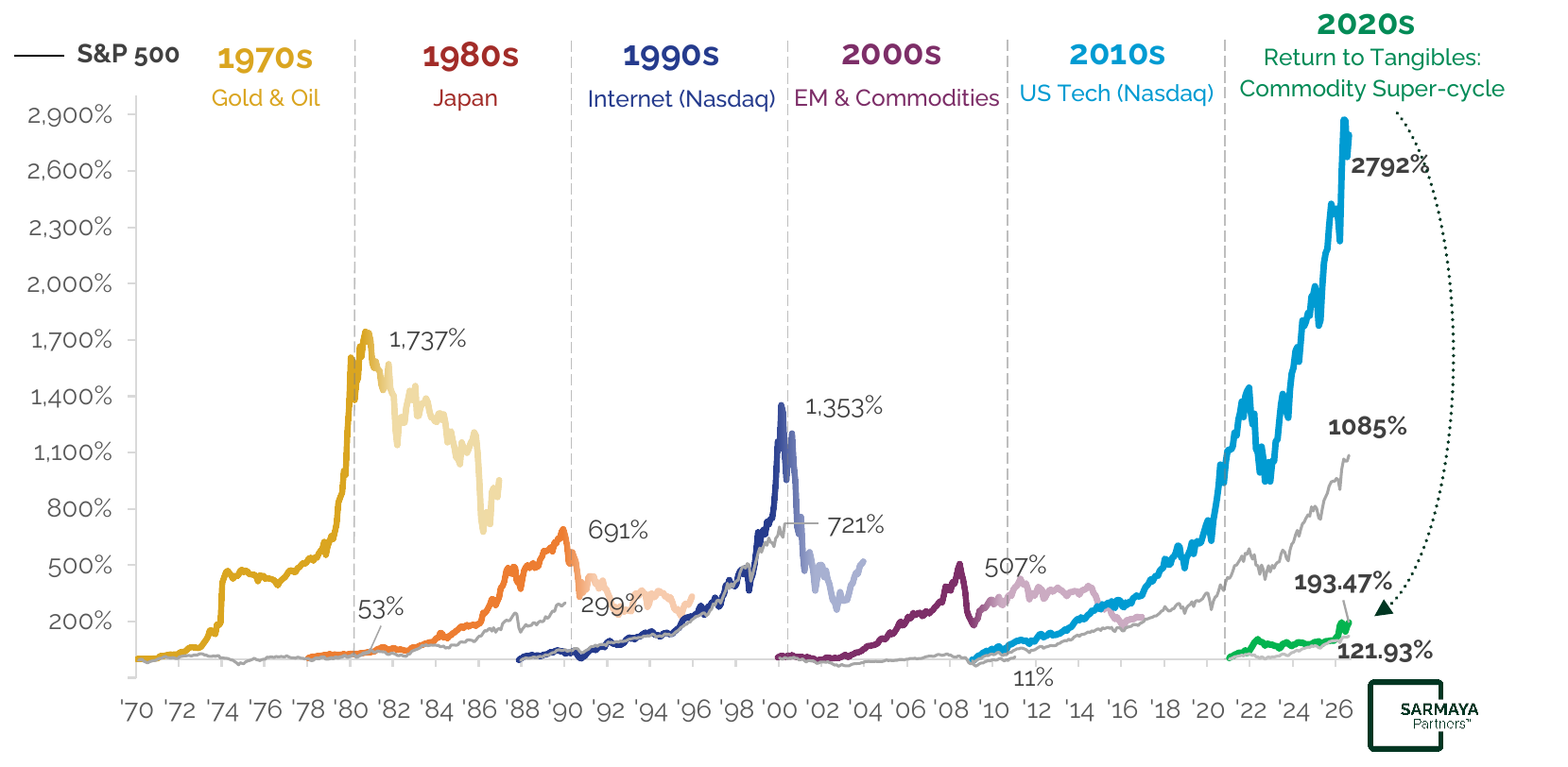
Themes representation: Gold & Oil 1970s: 50% Gold/50% Oil (Spot Prices); Japan 1980s: Topix Index; Internet 1990s: Nasdaq Composite Index; EM & Commodities 2000s: 50% MSCI Emerging Markets Index/50% S&P GSCI Dynamic Total Return Index; US Tech 2010s: Nasdaq-100 Index, Commodity Cycle 2020s: S&P GSCI Dynamic Total Return Index. Subject to change. Should not be considered investment advice. Prior bull markets also experienced significant and prolonged declines following their peaks. The current cycle’s return to date does not predict or imply future returns. Past performance is not indicative of future results.
Act I: The genesis of the Return to Tangibles (2021 to 2026)
The numbers
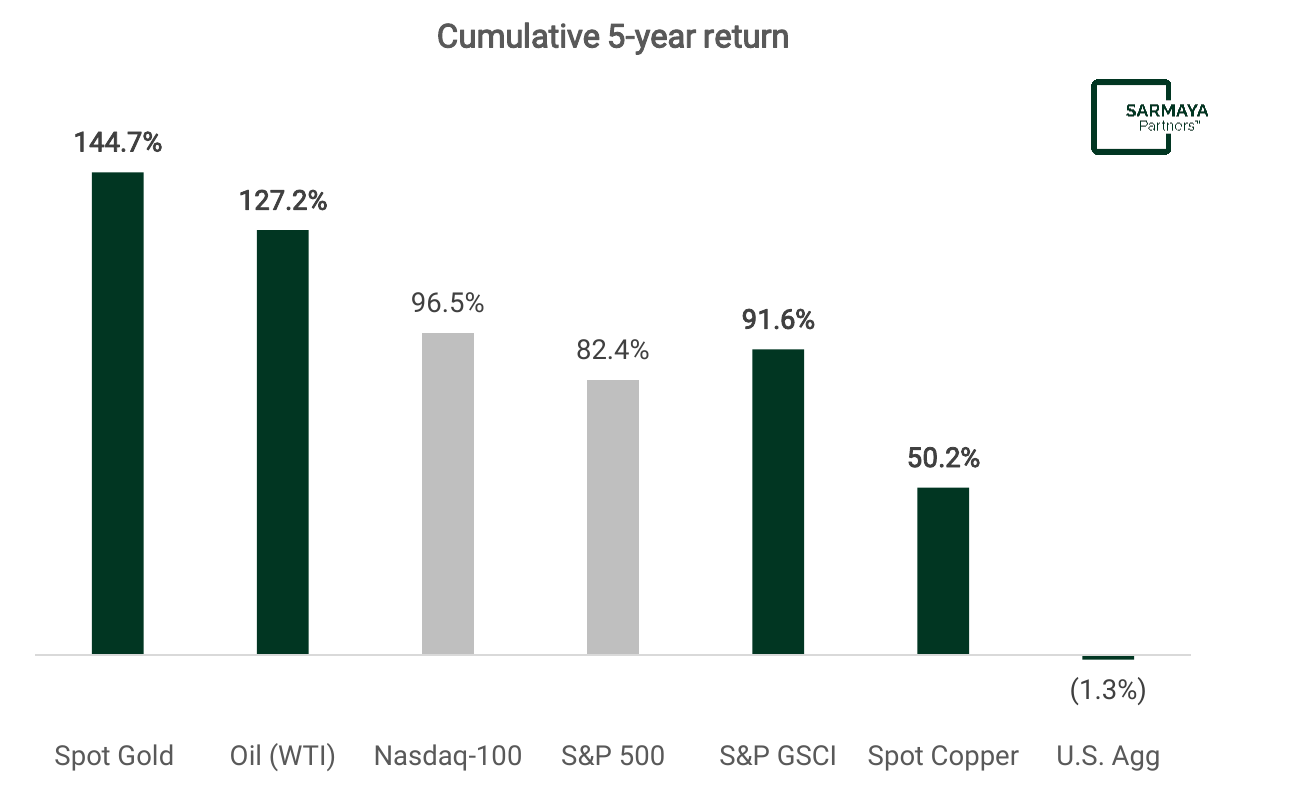
Since we first developed the Return to Tangibles framework in late 2020 and then published our inaugural paper in 2024, tangible assets have broadly kept pace with the market indices, while the key exposures of oil and gold in our sub-themes have led (see the 5-year performance in the chart below).
Gold and oil have led broad indices over the past five years
Past performance is not indicative of future results.
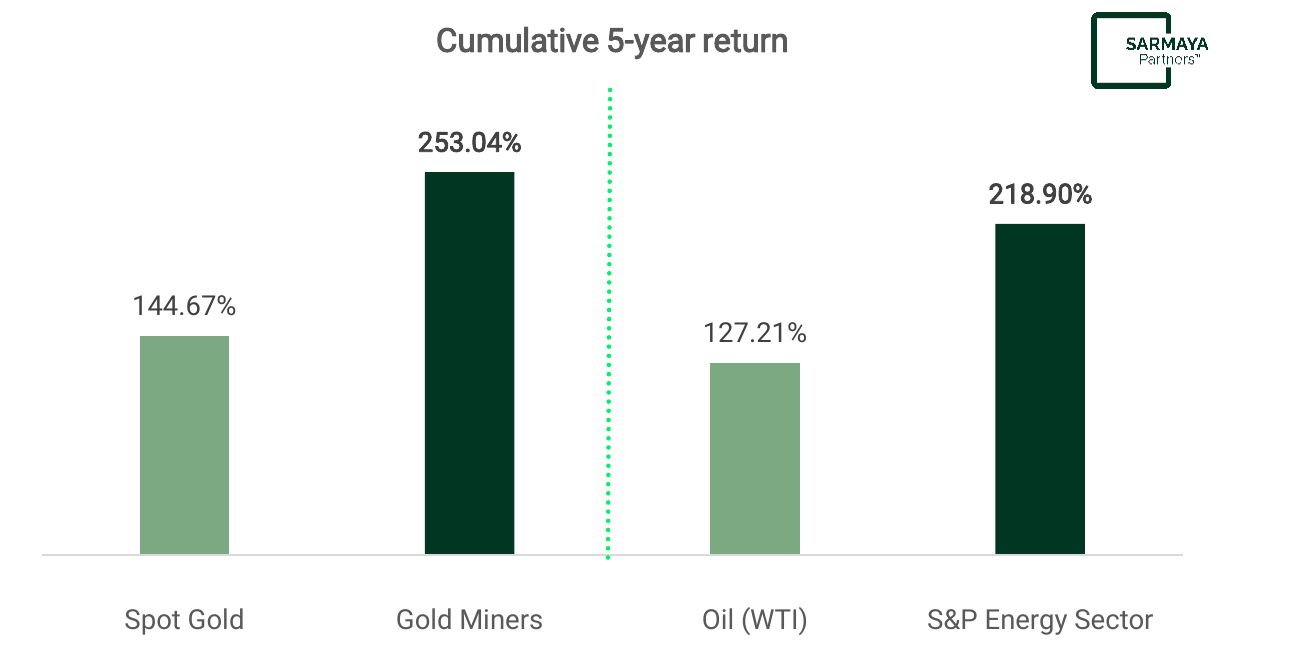
Moreover, the equities of those commodities, energy and gold miners, have fared better still.
AND Gold miners and energy equities have outperformed the underlying commodities
Past performance is not indicative of future results.
Return to Tangibles drivers and catalysts
“The present is the past rolled up for action, and the past is the present unrolled for understanding.” ~ Will & Ariel Durant
History is not a series of events disconnected from the present. It is the reason the present is the way it is. Thus, the seeds of the Return to Tangibles cycle were planted in the aftermath of the Great Financial Crisis (GFC) in the deflationary era of 2009 – 2020 leading up to the pandemic.
The combination of the near-free money of the Zero Interest Rate Policy (ZIRP) of those times and the shale energy supply-glut-induced cheap energy prices lulled the world into taking the low prices of both these foundational ingredients for granted. The world began to believe that we were past the archaic times of constrained resources. We began to believe that we didn’t need those ugly, dirty, grimy commodities in the new emerging digital and virtual world.
However, a series of catalysts, starting with the first inflation spike in 2021, then following on with the Russia-Ukraine war in 2022, the rise in the U.S. deficit, the tariffs, the simmering cold war 2.0 with China, and now the Iran war, have returned the world to the era of tangibles. An era where financial paper wealth not only struggles to procure the necessary tangible assets for economic security and progress but also loses its relative strength and value versus those tangible assets. This process started out so slowly in the early years that it was dismissed as temporary by many, except by a few including us. The Return to Tangibles has since gained momentum, grown in scope and impact, and continues to accelerate.
Return to Tangibles commodity super-cycle will likely be a multi-year secular theme driven by three primary drivers.
1. Inflation reawakens in a new macro backdrop
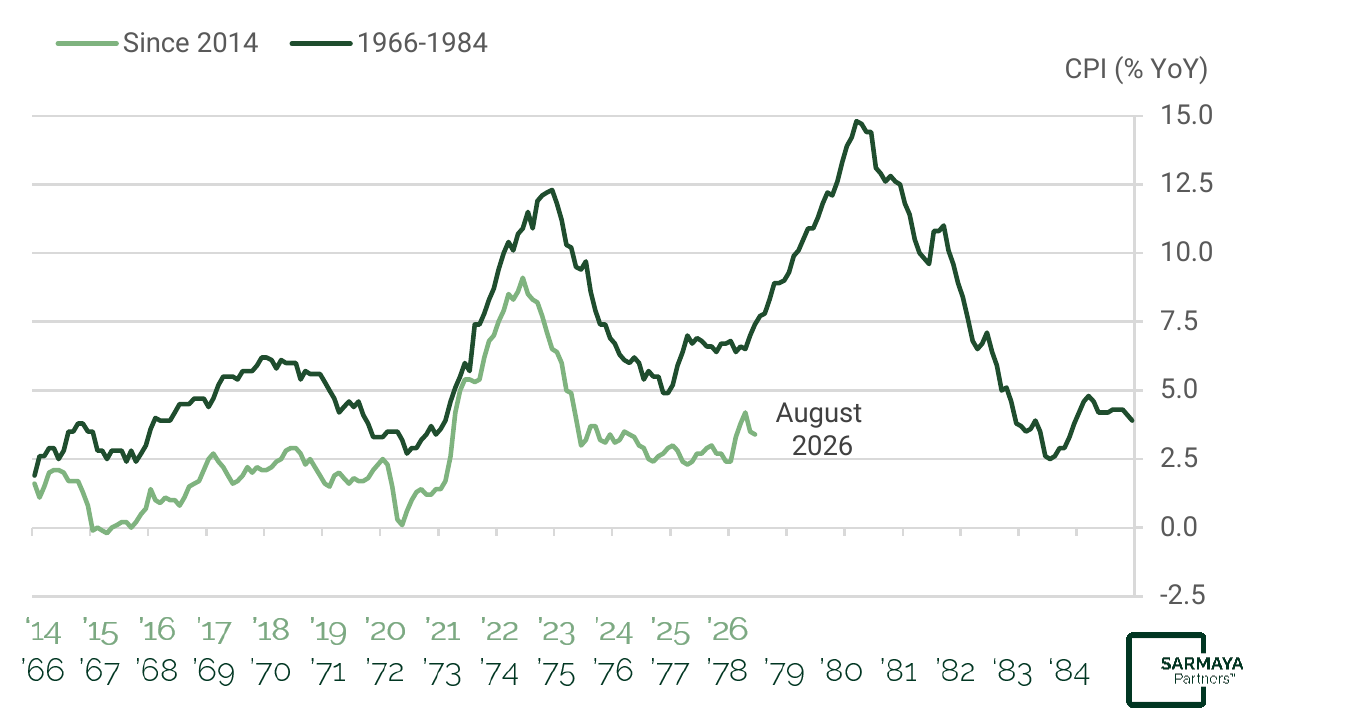
Since the pandemic, the general game plan for policy makers to spur economic growth and realign to a deglobalizing world has been a “run it hot” economic policy similar to the 1950s. Led by A.I. capex and energy infrastructure spending, supply chain reconfigurations, and reshoring, this approach could spur an inflationary boom, pushing the economy higher while simultaneously deflating away the national debt.
However, with recurring supply-side price shocks, rising capital costs, and lopsided growth, that game plan risks creating a 1970s-style stagflationary bust, leading to higher for longer inflation with low to negative economic growth.
We are in the top half on inflation-growth quadrant
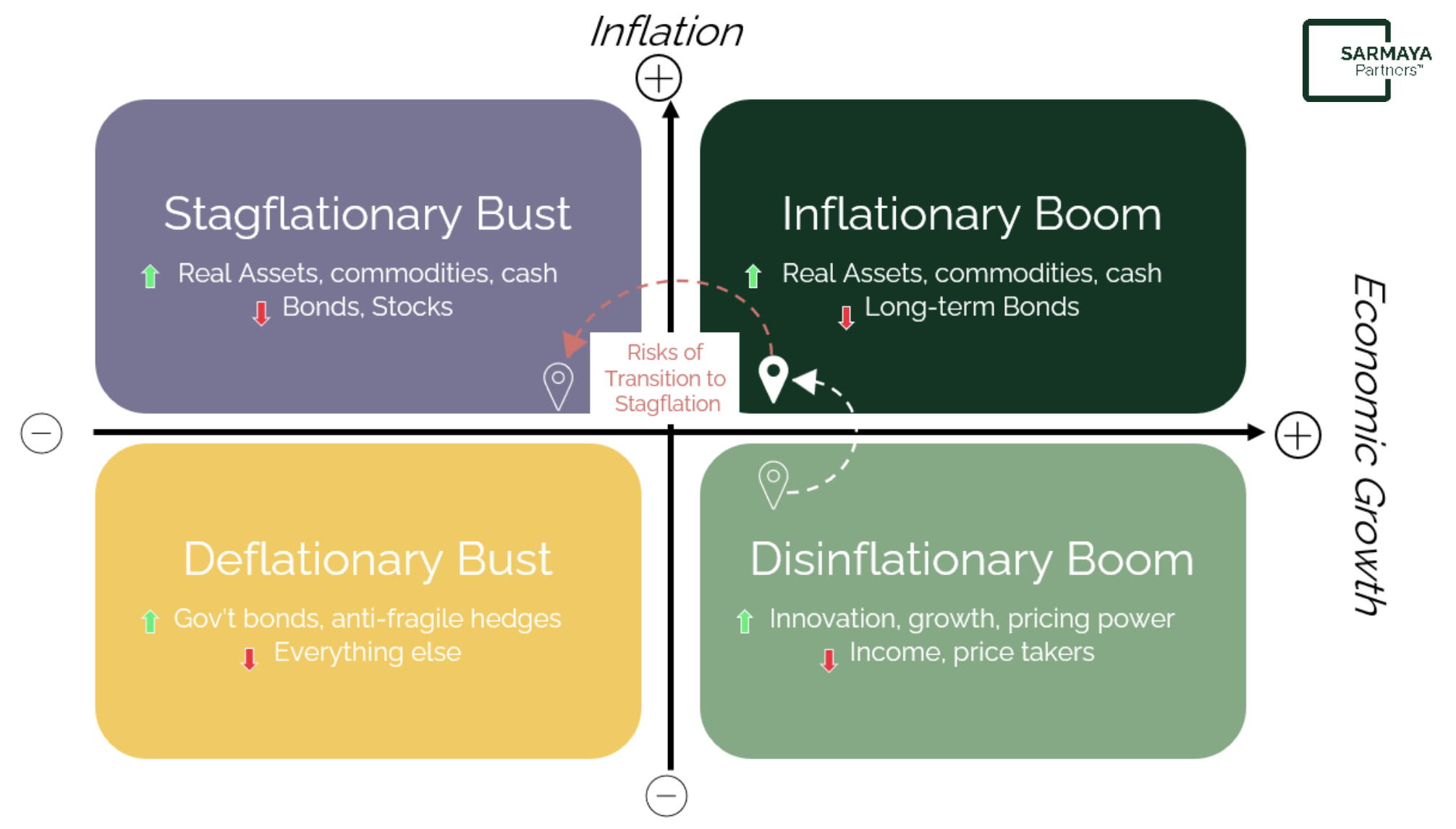
In our view, either scenario creates higher levels of inflation, and the world stays in the top half of the quadrant grid. The top half of the grid is an environment where tangible assets lead the market while duration assets like bonds and, potentially, growth equities struggle as interest rates normalize upwards.
Inflation trends resemble the 1970s
2. Shifting global landscape
Since the GFC, the world has been on a path away from globalization and toward competition. The shift was slow moving and barely noticeable at first; its earliest symptom was the currency wars of the 2010s. It gathered steam as the Russia-Ukraine war, the tariffs and the bubbling cold war 2.0 between the U.S. and China came to the forefront.
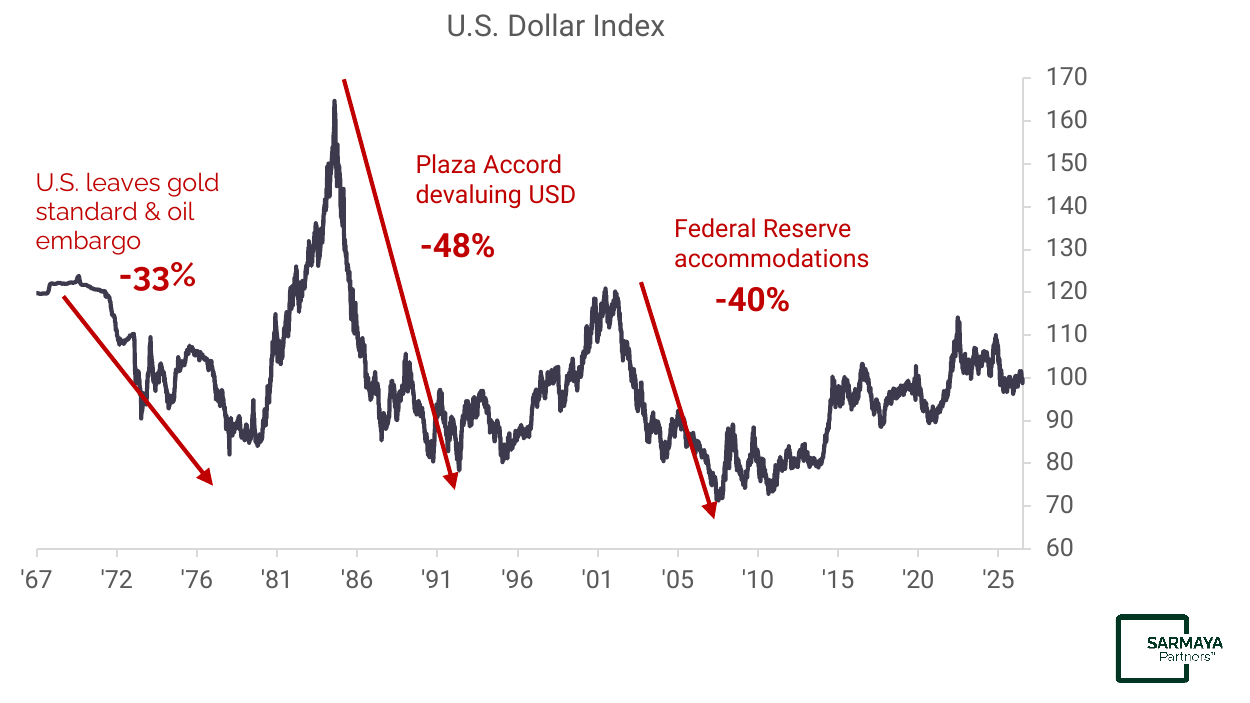
The fallout from these major milestones is not just more upward inflationary pressures, but also the rising probability of a secular downward move in the U.S. dollar.
To be clear, we’re not in the de-dollarization camp. We are in the camp that the U.S. dollar is in the early stages of a secular bear market, like the last three bear markets shown in the chart below. All three of these U.S. dollar declines were also periods of a commodity bull market, which would make sense intuitively as most if not all commodities are priced and traded in dollars. We believe this dollar bear market will not be different in that respect and will be an additional contributing factor in this Return to Tangibles commodity super-cycle much like the prior ones.
U.S. dollar direction impacts commodities
3. Investment cycle fundamentals
Typically, commodity super-cycles are demand-driven investment cycles: a renewal in production and capacity investment after a period of underinvestment, which is usually in the aftermath of an overbuilding and overcapacity bust. The last commodity bust, which started in the 2010s and lasted through the early pandemic months, was also such a secular downturn. This bust cut deeper than most, exacerbated by the untimely combination of a U.S. shale-driven energy supply glut and China’s efforts to right-size its housing and construction bubble. Adding the severe deflationary vortex created by the GFC’s economic implosion and the ESG movement to this mix made for a painful decade for commodities.
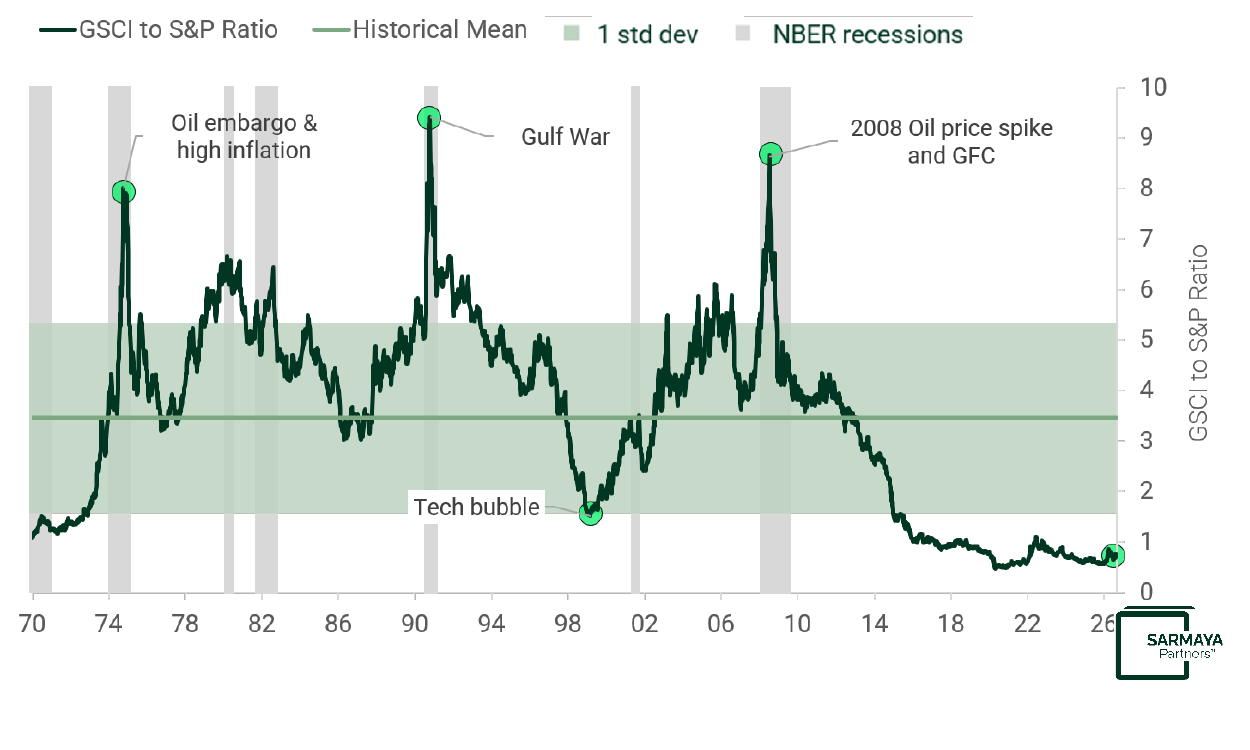
On the flipside, these were also the ZIRP years: a macro backdrop that allowed for longer duration assets such as fixed income and growth equities such as technology to thrive, leading stocks to outperform commodities as seen in the chart below.
After years of being unloved, ignored, and under-owned, commodities are being rediscovered. Investors are beginning to wake up to their exceptional relative value versus equities, especially in energy and mining.
Commodities remain near historical lows relative to S&P 500
Historical patterns do not guarantee future outcomes.
Return to Tangibles decomposed into its three sub-themes
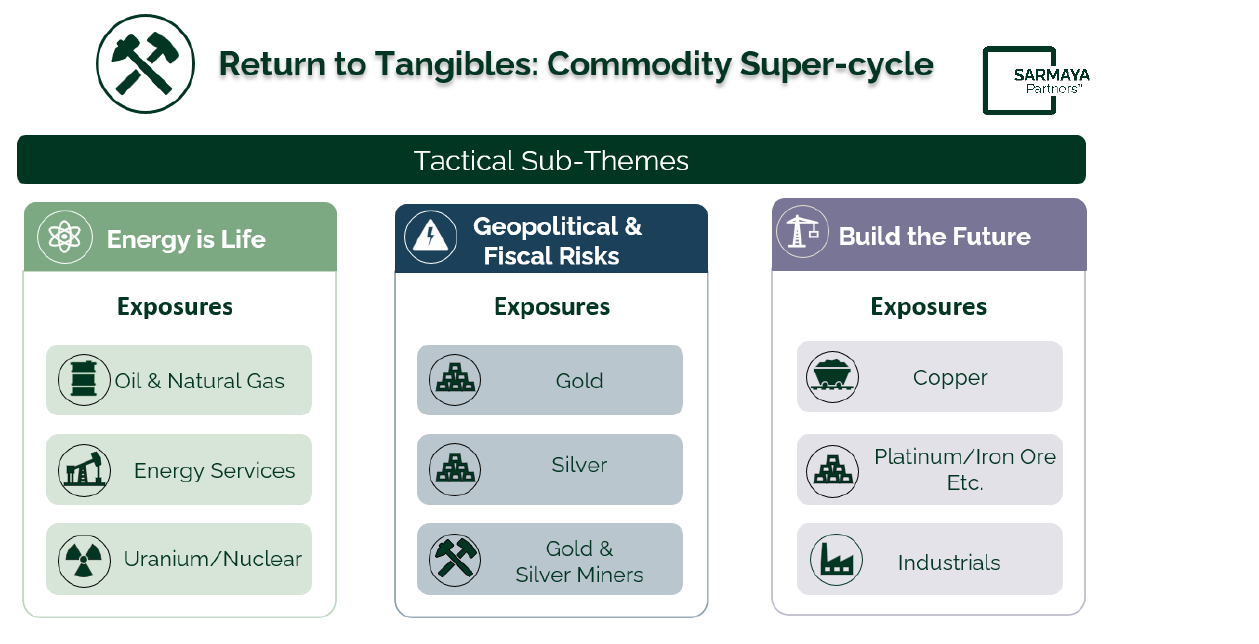
We decompose our Return to Tangibles commodity super-cycle secular theme into three key sub-themes. We believe these sub-themes will be the key drivers of the cycle, and their underlying exposures the primary beneficiaries. As shown in the chart below, they are Energy is Life, Geopolitical & Fiscal Risks, and Build the Future.
Energy is Life
The main exposures in Energy is Life are oil & natural gas and their service providing companies as well as uranium mining and nuclear companies. After years of underinvestment and neglect, energy, especially oil and natural gas, is again being recognized as a foundational ingredient of both economic prosperity and national security.
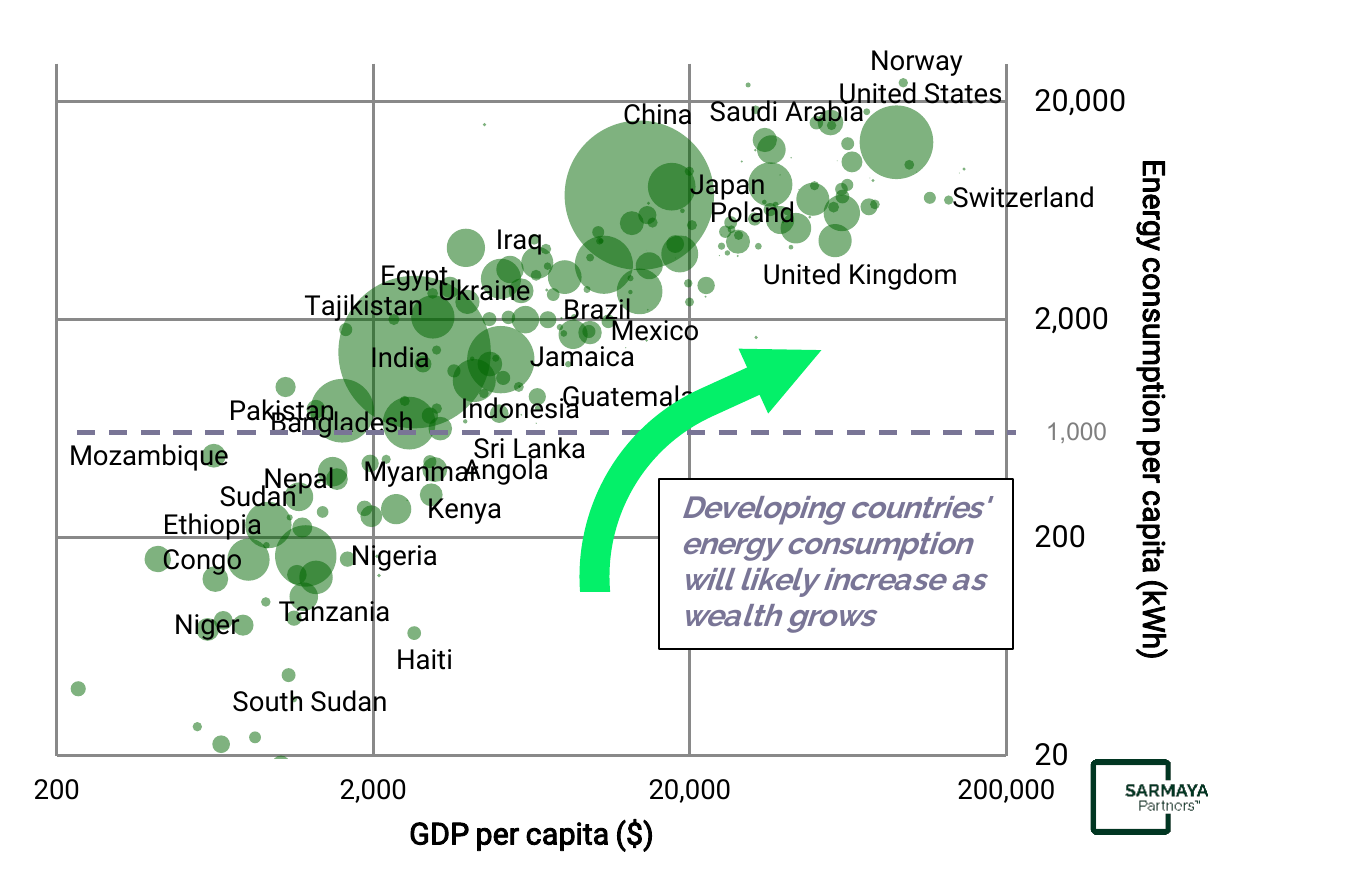
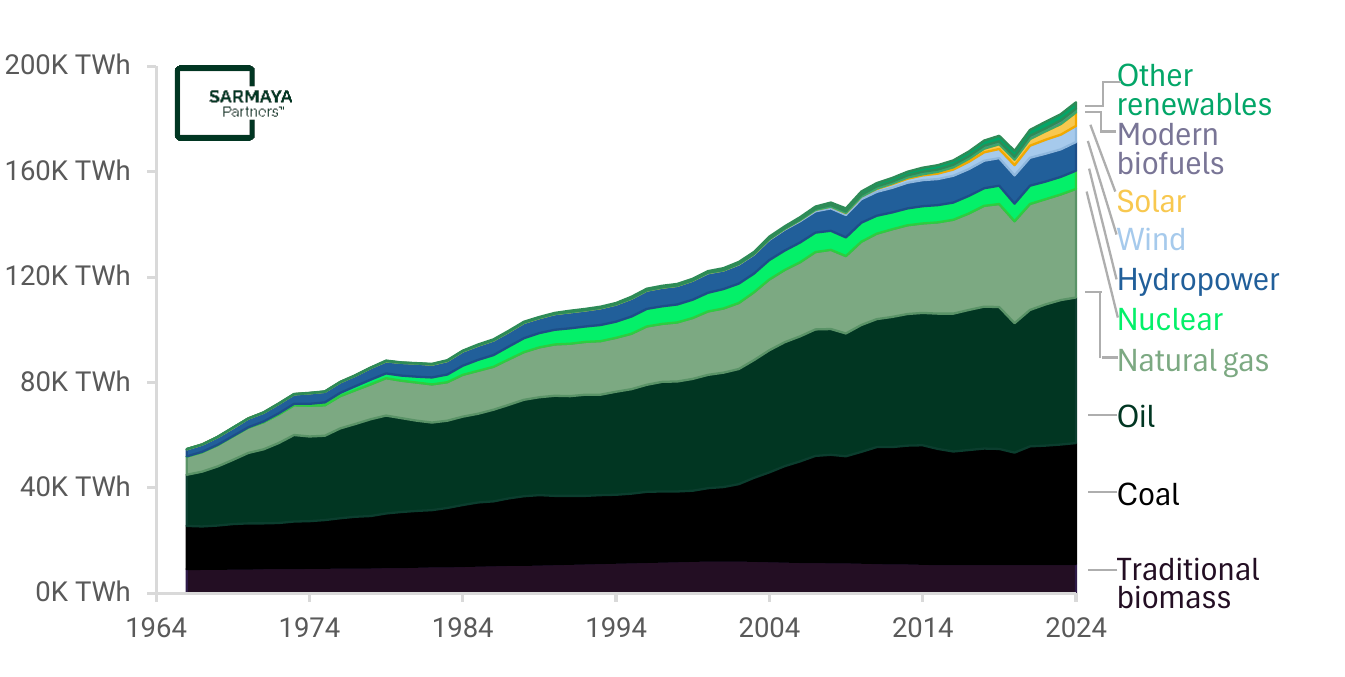
The two charts highlight energy’s critical importance in economic prosperity and security. The world has continued to grow its usage of energy almost without interruption despite greater efficiencies, and oil and natural gas make up the largest part of the energy mix. Additionally, economic prosperity is closely tied with the usage of energy. As a country prospers economically, its energy footprint rises with it. You don’t get economic prosperity without energy, and as you prosper, you use more of it.
We expect this phenomenon, energy’s Jevons Paradox, to continue requiring more energy, not less. And we expect oil and natural gas to continue to play a pivotal role in that energy mix for many years to come.
Global energy needs far from peak
Global energy consumption by source
The escalating geopolitical events over the past several years reinforce our view that energy policy is closely intertwined with national security and economic growth policy. We believe this relationship never went away; it merely faded into the background as the era of free money and cheap energy led the world to take it for granted.
Geopolitical & Fiscal Risks
Gold, silver and their mining companies are the central exposures in the Geopolitical & Fiscal Risks sub-theme.
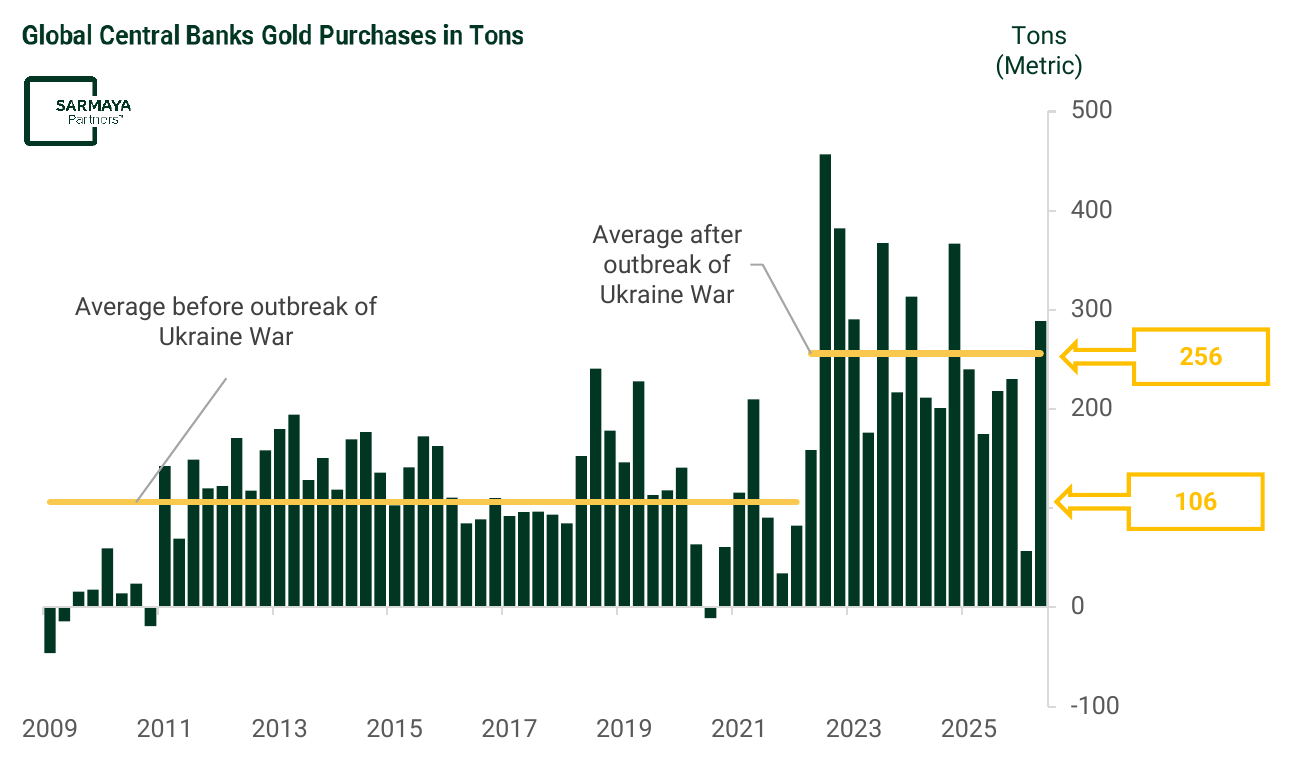
The world’s geopolitical risk level, which has been gradually heating up since the GFC, kicked into high gear in 2022 when Russia’s dollar and euro foreign reserves were frozen by the U.S. and Europe after it invaded Ukraine. That weaponization of the reserve-currency system can be seen as the catalyst for the increase in global central banks buying gold as they increasingly sought to diversify their U.S. dollar and Treasury holdings. (see chart below).
Central banks buying more gold
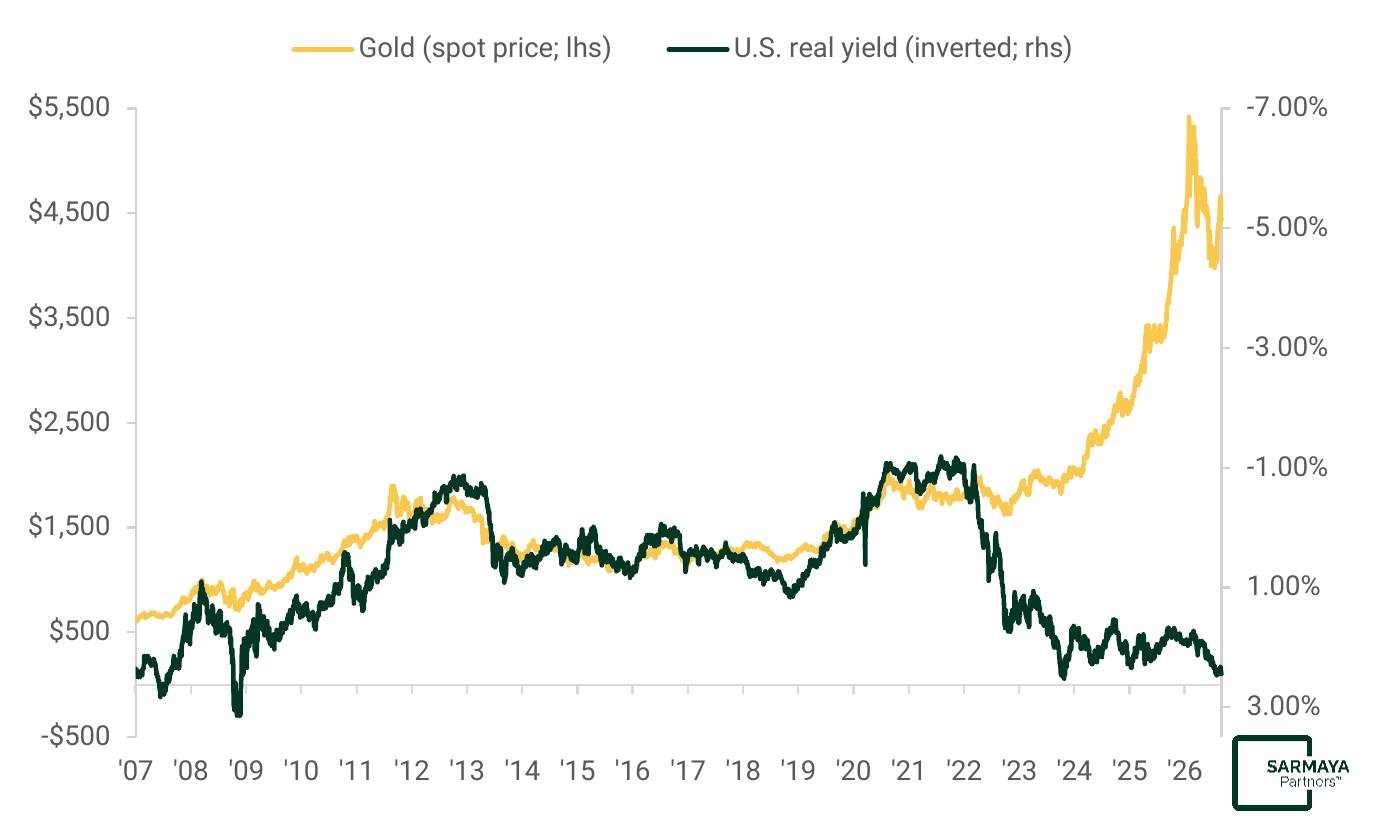
Even though gold had an early move above $2,000 during the pandemic’s stimulus-driven emergence of inflation, the clear price breakout occurred in 2024 as gold kept on rising despite rising U.S. real rates. That decoupling was a sign that gold had a bid by a systematic and consistent buyer (global central banks) that was motivated by geopolitical drivers and was indifferent to U.S. real rates.
Decoupling in gold and real rates?
The primary driver of precious metals and their miners in the Geopolitical & Fiscal Risks sub-theme in Act I has been the geopolitical side of the ledger. The fiscal side of the story started bubbling up in 2026. In our view, these two developments, the fiscal turn and the Iran war, are the primary catalysts that have moved the Return to Tangibles into Act II, the second phase of the secular cycle.
We will discuss the fiscal part of the sub-theme, as well as the fallout from the Iran war, in detail in the next paper covering Act II.
Build the Future
The key exposure in the Build the Future sub-theme is copper mining companies. Despite the macro challenges, the world will continue to build the infrastructure: A.I. data centers in the developed markets and broad infrastructure across the emerging nations. Additionally, we believe that ebbing globalization and the elevated geopolitical tensions of a multipolar world will drive duplicative and redundant industrial capacity and supply chains.
Copper discoveries are low amid rising demand
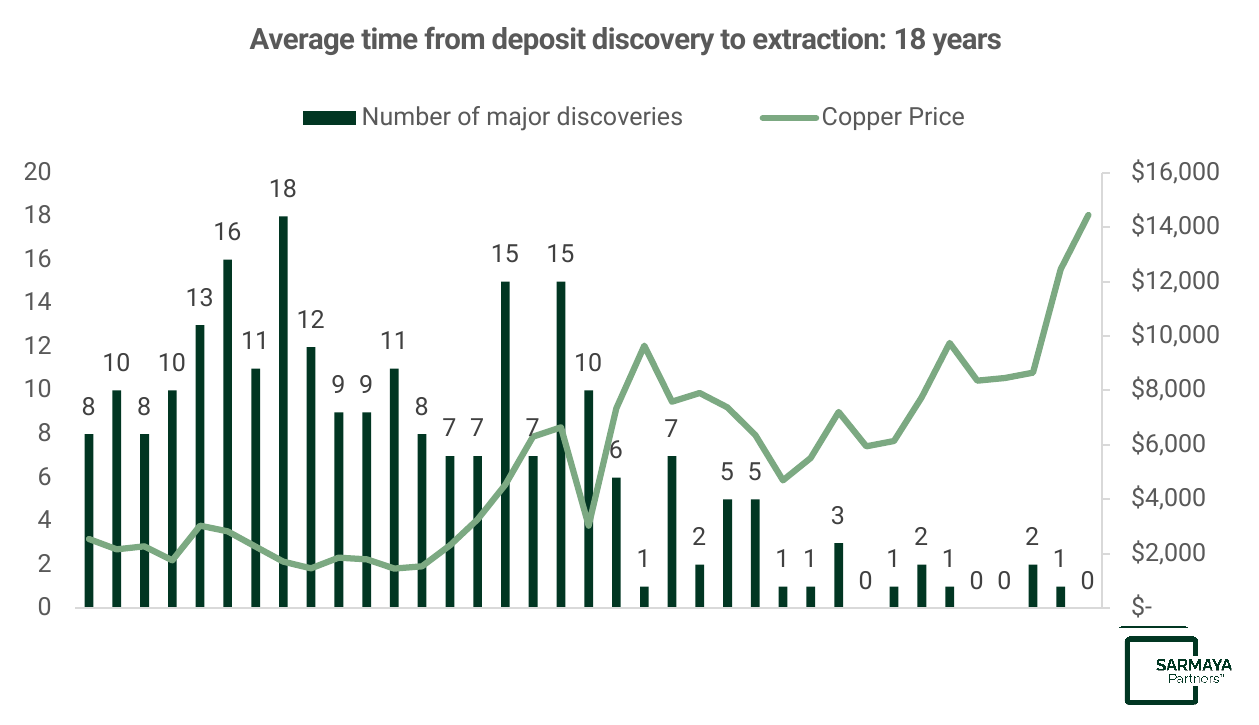
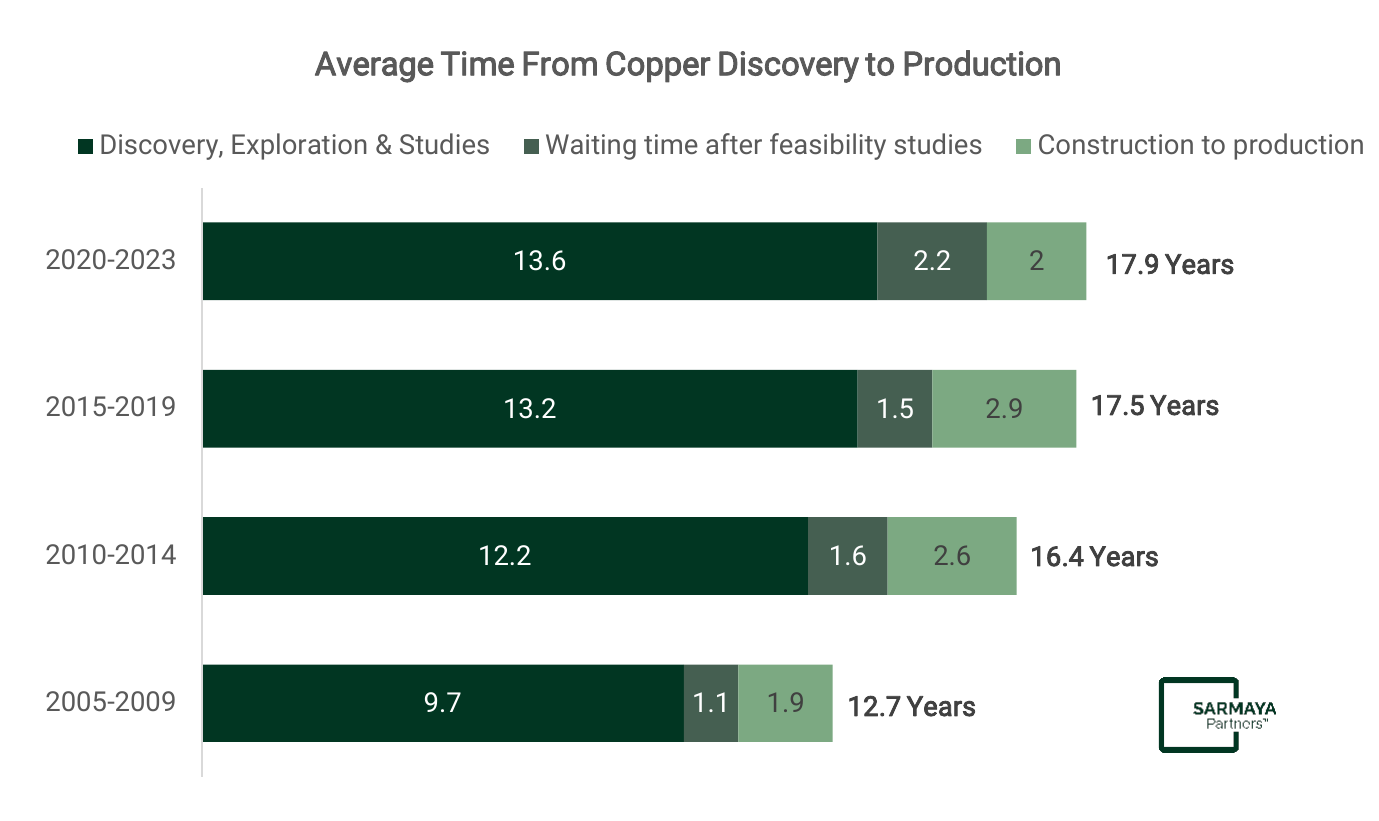
Irrespective of where it happens, or who builds it, all this build-out will require the foundational ingredients of copper and iron ore among others. Meanwhile, copper production remains limited in the face of this rising demand as it takes multiple years to bring production online. While there will be multiple tactical opportunities in other metals and minerals such as tungsten, platinum or lithium, in our view the long-term secular opportunity is in copper.
Copper production taking longer to come online
In addition to being a precious metal, platinum also has industrial uses, particularly in the automotive sector. At the start of the EV adoption cycle, it looked like demand for platinum, which is used in catalytic converters, would fall. But the opposite has happened as North American consumers have slowed their shift to EVs, and instead preferred hybrid vehicles, which rely heavily on platinum inputs. Low spot prices also disincentivized production, widening the supply-demand shortage.
This global infrastructure buildout will require a backbone made of steel. That steel will need to be made from iron ore, whose mining companies are also in the Build the Future sub-theme.
Act II and beyond: Geopolitical & Fiscal Risks and Energy is Life (2026 onward)
“In economics, things take longer to happen than you think they will, and then they happen faster than you thought they could.” ~ Rudiger Dornbusch
We believe 2026 marks the transition of the Return to Tangibles commodity super-cycle from the first phase (Act I) of genesis, and its disbelief by many, to the second phase (Act II) where the macro and fundamental factors become apparent to the broader market. The geopolitical escalation in the Iran war, moving oil and energy security to the forefront, and the U.S. fiscal deficit freight train risking derailment have been events for the history books. They have also acted as the catalysts for pushing Return to Tangibles into Act II. We will cover these events and their impacts as well as the likely path we see for our sub-themes and their exposures in the next paper. We will then cap the series with a note on Act III, laying out the catalysts and milestones we would look for to enter that phase.
Disclosures
Sarmaya Partners, LLC is a registered investment adviser with the U.S. Securities and Exchange Commission. SEC registration does not imply a certain level of skill or training.
This material is for informational purposes only and does not constitute an offer to sell, a solicitation to buy, or a recommendation for any security, strategy, or investment product. Nothing herein should be construed as investment, legal, tax, or accounting advice.
The views expressed reflect Sarmaya Partners’ opinions as of the date of publication and are subject to change without notice. These views represent the firm’s current assessment of market conditions and do not account for any individual investor’s financial situation, objectives, or risk tolerance.
This material contains forward-looking statements based on the firm’s current expectations regarding inflation, energy markets, monetary policy, and asset class performance. Forward-looking statements are inherently uncertain, and actual outcomes may differ materially. Readers should not place undue reliance on such statements.
References to specific asset classes, commodities, or investment themes, including the “Return to Tangibles” framework, reflect the firm’s current market outlook and do not constitute a recommendation to buy or sell any security or commodity. Commodity and natural resource investments involve risks including price volatility, geopolitical disruption, supply and demand uncertainty, and regulatory change. Past performance is not indicative of future results. All investments involve risk, including possible loss of principal.
Certain data has been obtained from third-party sources including Bloomberg, World Gold Council, EIA, World Bank, Our World in Data, Energy Institute, S&P Global and NBER. While believed to be reliable, Sarmaya Partners makes no representation as to its accuracy or completeness.
© 2026 Sarmaya Partners, LLC. This material may not be reproduced or distributed without prior written consent.
September 15, 2026