



“In the stock market, the most important organ is the stomach. It’s not the brain.” ~ Peter Lynch
Bottom Line Upfront: Markets continue to be tormented by the U.S.’ increasingly emerging market-like public policy instability.
- We see the “Sell America” market reaction gaining momentum as pressure builds on the dollar, equities, and Treasurys.
- Recession risk in the S. is clearly elevated, with the combination of fiscal tightening, tariff shocks, and Fed hesitancy forming a toxic mix.
- The path for equities, especially large cap growth, remains lower over the coming We prefer exposure to gold and tangibles-related equities.
- We don’t see a resolution to the self-inflicted tariff panic anytime soon as this is now a political-ideology-driven move that won’t stop until we have a negotiated resolution, or something breaks.
As if the tariffs weren’t enough, the markets are now panicked by the potential removal of Jay Powell, a move that could trigger a Liz Truss-style bond market reaction in the U.S. The President’s messaging has awakened a “Sell America” market reaction with U.S. stocks, bonds and the dollar all declining. What’s unfolding resembles classic emerging market dynamics, with policy risk dominating and institutional credibility eroding. This has led to global diversification finally mattering again after being dormant for 15 years.
What seems clearer is that the fiscal dominant environment of the past several years has resulted in unsustainable deficit levels that need to be addressed.
Markets are no longer responding predictably to policy easing – a warning sign: The bond market is growing increasingly uncomfortable about rate cuts, as evidenced by the Fed’s 50 bps move in September that sent long bond yields higher, not lower.
Faced with costly tariffs, fiscal tightening and a reluctant Fed fearful of sticky inflation, the U.S. economy is flirting with a recession. While not a certainty, as tariffs can be negotiated to a manageable level and the Fed could re-engage to support the market, the risks have indeed risen over the last couple of months. The longer uncertainty persists for corporations, the greater the risks the economy jams up later this year.
For risk assets, this spells trouble, especially for U.S. large cap growth stocks. With valuations still rich and macro risks rising, these names are likely to remain under pressure and the buy-the-dip crowd will continue to get burned as the path for the next several months is likely down. In the current environment, tangibles exposures in mining, oil, gas, copper and uranium in sectors like materials, energy and industrials, both in the U.S. and overseas are looking attractive. Especially since these areas have already priced in much of an economic slowdown and trade at valuations that provide somewhat of a margin of safety. Meanwhile gold, the King of the Tangibles, continues to march higher, reaffirming its role as the tier 1 geopolitical and haven asset it has been for millennia.
“In the stock market, the most important organ is the stomach. It’s not the brain.”
– Peter Lynch
Bottom Line Upfront: Markets continue to be tormented by the U.S.’ increasingly emerging market-like public policy instability.
- We see the “Sell America” market reaction gaining momentum as pressure builds on the dollar, equities, and Treasurys.
- Recession risk in the U.S. is clearly elevated, with the combination of fiscal tightening, tariff shocks, and Fed hesitancy forming a toxic mix.
- We believe the path for equities, especially large cap growth, remains lower over the coming months, and we prefer exposure to gold and tangibles-related equities. Of course, tariffs can be negotiated down and the Fed can re-engage, but we view this as a less likely outcome.
- We don’t see a resolution to the self-inflicted tariff panic anytime soon as this is now a political-ideology-driven move that won’t stop until we have a negotiated resolution, or something breaks.
As if the tariffs weren’t enough, the markets are now panicked by the potential removal of Jay Powell, a move that could trigger a Liz Truss-style bond market reaction in the U.S. The President’s messaging has awakened a “Sell America” market reaction with U.S. stocks, bonds and the dollar all declining*. What’s unfolding resembles classic emerging market dynamics, with policy risk dominating and institutional credibility eroding. This has led to global diversification finally mattering again after being dormant for 15 years.
What seems clearer is that the fiscal dominant environment of the past several years has resulted in unsustainable deficit levels that need to be addressed. Markets are no longer responding predictably to policy easing – a warning sign: The bond market is growing increasingly uncomfortable about rate cuts, as evidenced by the Fed’s 50 bps move in September that sent long bond yields higher, not lower.
Faced with costly tariffs, fiscal tightening and a reluctant Fed fearful of sticky inflation, the U.S. economy is flirting with a recession. While not a certainty, as tariffs can be negotiated to a manageable level and the Fed could re-engage to support the market, the risks have indeed risen over the last couple of months. The longer uncertainty persists for corporations, the greater the risks the economy jams up later this year.
For risk assets, this spells trouble, especially for U.S. large cap growth stocks. With valuations still rich and macro risks rising, these names are likely to remain under pressure and in our view the buy-the-dip crowd will continue to get burned as the path for the next several months is likely down. We believe that in the current environment, tangibles exposures in mining, oil, gas, copper and uranium in sectors like materials, energy and industrials, both in the U.S. and overseas are looking attractive. Especially since these areas have already priced in much of an economic slowdown and trade at valuations that provide somewhat of a margin of safety. Meanwhile gold, the King of the Tangibles, continues to march higher, reaffirming its role as the tier 1 geopolitical and haven asset it has been for millennia.
The Truss episode is a useful illustration and not a forecast. US and U.K. market structures, central bank frameworks, and reserve currency dynamics differ materially.
Commodities at Historical Bottom Relative to S&P 500
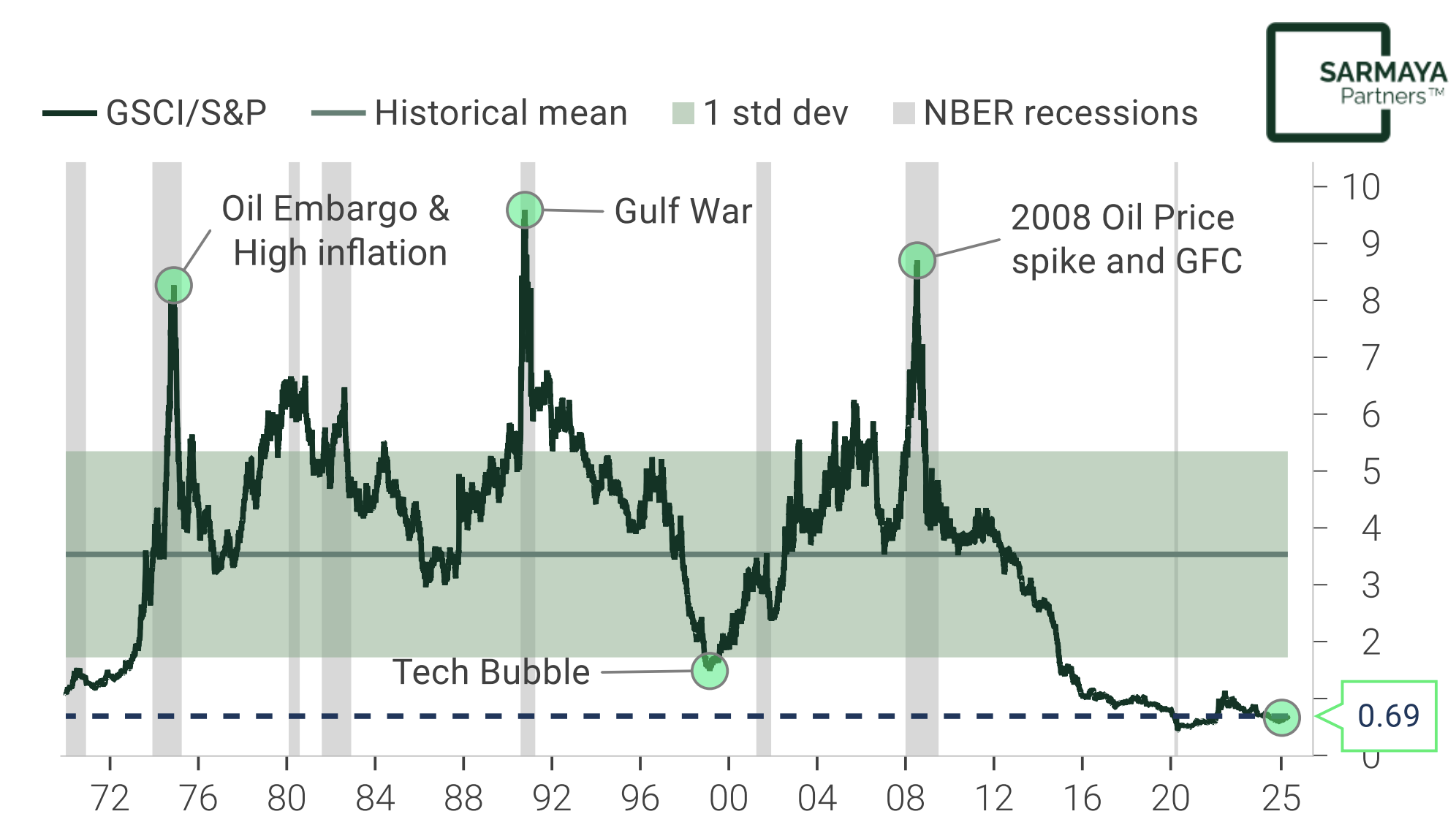
Source: Sarmaya Partners; Macrobond
Note: Illustrative only. Past valuation relationships between asset classes are not predictive of future relative performance.
Gold Price since 1964
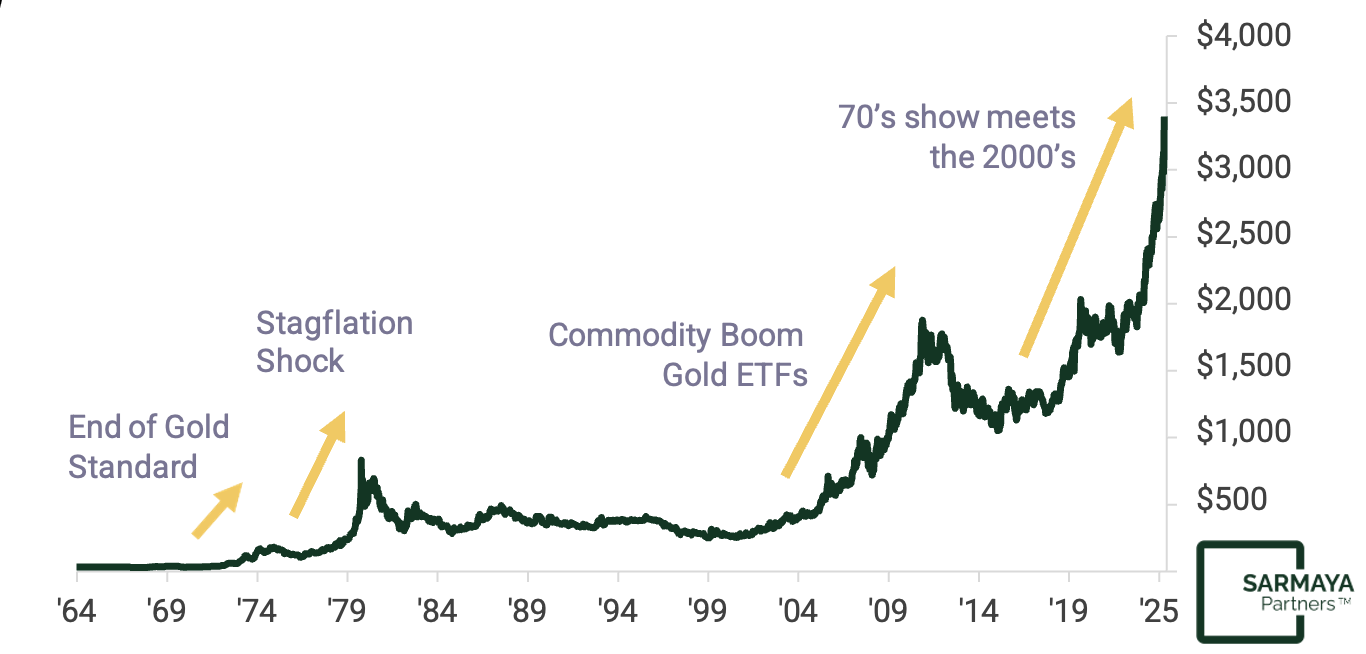
Source: Sarmaya Partners; Bloomberg
Note: Past performance is not indicative of future results. Gold prices are volatile and can decline significantly.
The next few months are likely to remain choppy as we go through the 90 day “wait and see” period on tariffs. Things could get even more rocky if the threat to terminate Powell isn’t walked back. If it materializes then a liquidity crunch is very much on the table, which could see a short-term US dollar bounce within the longer term weakened cycle.
With earnings season kicking into high gear amid the tariff tantrum, the outlook provided for the future will be more important than the results. Guidance will be increasingly important for investors as they gauge how companies are navigating the current uncertainty. However, if the macro policy continues to dominate investors’ attention, corporate earnings will likely not matter as much.
Disclaimers
Sarmaya Partners, LLC is a registered investment adviser with the U.S. Securities and Exchange Commission. SEC registration does not imply a certain level of skill or training.
This material is for informational purposes only and does not constitute an offer to sell, a solicitation to buy, or a recommendation for any security, strategy, or investment product. Nothing herein should be construed as investment, legal, tax, or accounting advice.
The views expressed reflect Sarmaya Partners’ opinions as of the date of publication and are subject to change without notice. These views represent the firm’s current assessment of market conditions and do not account for any individual investor’s financial situation, objectives, or risk tolerance.
This material contains forward-looking statements based on the firm’s current expectations regarding equity markets, interest rates, trade policy, and asset class performance. Forward-looking statements are inherently uncertain and actual outcomes may differ materially. Tariff and trade policy conditions may be resolved more quickly or more favorably than described. Federal Reserve policy, equity market performance, and global economic conditions may develop differently from the views expressed herein. Readers should not place undue reliance on forward-looking statements.
References to the Liz Truss episode and U.K. gilt market events of 2022 are for illustrative purposes only. Historical market events are not predictive of future results. U.S. and U.K. market structures, central bank frameworks, and reserve currency dynamics differ materially, and similar outcomes should not be assumed.
References to specific asset classes, sectors, commodities, or investment themes, including gold, energy, materials, and the “Return to Tangibles” framework, reflect the firm’s current market outlook and do not constitute a recommendation to buy or sell any security or commodity. Commodity and natural resource investments involve risks including significant price volatility, geopolitical disruption, cyclicality, supply and demand uncertainty, and regulatory change. Gold prices are volatile and can decline significantly. Valuations that appear attractive relative to historical levels do not guarantee future outperformance. All investments involve risk, including possible loss of principal.
Certain data has been obtained from third-party sources including Bloomberg and Macrobond. While believed to be reliable, Sarmaya Partners makes no representation as to its accuracy or completeness.
© 2025 Sarmaya Partners, LLC. This material may not be reproduced or distributed without prior written consent.
April 21, 2025